Posts Categorized: Uncategorized

Warning Signs You Need an AC Replacement

Warning Signs You Need an AC Replacement

The time may be coming up for an AC replacement. Below are a few signs that would indicate that such a time has come. If you respond by having a professional come over and inspect the system, then you’re bound to get an honest recommendation about your next course of action.

1. The Age of the System

Packaged units and heat pumps have a life span of 10 to 15 years. This will vary, of course, based on the level of care that, up until then, the unit has received. If you never had yearly tune-ups done, then its life span will be significantly shorter.

2. Below-Average Cooling

One important sign to look for in a whole-house cooling system is uneven cooling between rooms and floors. The presence of “hot spots” may be explained by clogged air ducts or by a refrigerant leak; in either case, it shows that the system is getting old and worn.

In addition, you might notice that your unit blows out lukewarm air even several minutes after switching it on. It might also fail to remove humidity from your home.

3. Abnormally High Utility Bills

An aging system, especially one with clogs, leaks, or other issues, has to work harder to achieve the temperature you set. This is why you might experience unusually high electricity bills along with shoddy performance.

At Hopkins Air Conditioning, Inc., we know that one of the benefits of tune-ups is to keep electricity bills reasonable. Homeowners across West Palm Beach take advantage of our regular maintenance. They also enjoy our zoning systems, which cool only certain rooms so as to maintain energy efficiency.

4. Expensive Repairs

Some issues are so expensive to repair that getting a complete AC replacement is, in the long run, more cost-effective. One such example is a refrigerant leak — usually the main culprit when a system fails to remove humidity.

5. Ominous Sounds

If you hear a grinding noise, know that this may signify a worn-out compressor. If you hear a hissing or screaming sound, that may point to a refrigerant leak. It is clear, then, that some sounds can warn you to the need for an AC replacement.

Comprehensive Inspections and More

If you’re considering a replacement, turn to Hopkins Air Conditioning, Inc. We have NATE-certified technicians who can serve anyone in West Palm Beach. Our crew can handle all types of heating- and cooling-related services. As a Dave Lennox Premier Dealer, we carry premium AC products for all property sizes and for all budgets. Find out more by calling us today.
UV Lights for HVAC Systems: Are They Worth It?

UV Lights for HVAC Systems: Are They Worth It?

If the air in your Palm Beach home feels musty or smells moldy, consider a UV light for your HVAC system. These innovative devices use the power of ultraviolet (UV) light to kill bacteria, fungi, and viruses. But do they actually work, and are they worth the investment? Let the experts at Hopkins Air Conditioning explain the ins and outs of UV lights for HVAC systems.

What Are UV Lights in HVAC Units?

UV lights are a powerful tool in the fight against indoor air pollution. These lights emit UVC rays, a type of UV light powerful enough to kill microscopic organisms, including bacteria, fungi, and viruses.

Here are two ways you can install UV lights in your HVAC system:

  • Coil sterilization: With this method, UV lights are installed near the evaporator coil to prevent mold and bacteria buildup.
  • Air sterilization: Air sterilizing UV lights are installed in the ductwork to purify your home’s air as it circulates through your HVAC system.

By targeting these critical areas, UV lights help maintain both the efficiency of the HVAC system and your indoor air quality.

Benefits of UV Lights for AC Units

Once you install a UV light in your AC system, it will sanitize your home’s air. Here are some other benefits of UV lights in your AC unit:

  • Improved air quality: UV lights significantly enhance indoor air quality by killing airborne pathogens, making your home safer and more comfortable for those with allergies and respiratory issues.
  • Odor reduction: UV lights can help reduce or eliminate odors caused by mold, bacteria, and other pollutants.
  • Enhanced efficiency: Clean coils and ducts reduce the strain on your HVAC system, decreasing energy consumption and lowering utility bills.
  • Reduced maintenance: UV lights help prevent mold and bacteria buildup, reducing the need for frequent cleanings and maintenance.

Considerations Before Installing UV Lights in Your AC System

While UV lights are a beneficial addition to your AC system, there are some aspects you should consider before investing in them:

  • System compatibility: Not all HVAC systems can integrate a UV light. Work with a licensed professional to ensure your HVAC system is compatible with UV light installation.
  • Initial cost: While UV lights are a worthwhile investment, they require an initial installation cost and ongoing maintenance. Choose an HVAC contractor that offers financing to help you fit the purchase into your budget.
  • Installation requirements: Proper installation is crucial for UV lights to function properly. Hiring a professional ensures the lights are correctly placed and wired for optimal performance.

Choose Hopkins Air Conditioning for HVAC Services

UV lights keep your air clean and offer many other benefits, such as improved AC performance. Still, it’s important to work with a professional to determine if UV lights are a good fit for your home.

With Hopkins Air Conditioning, you’ll have a reliable partner to guide you through UV light installation and ensure your home remains comfortable year-round. Our team of licensed and insured technicians is dedicated to delivering high-quality work and exceptional customer service. You can rely on us for your AC needs.

Contact us today for a free estimate and discover how UV lights can benefit your home.

Tips to Maintaining Good Indoor Air Quality

Tips to Maintaining Good Indoor Air Quality

When it comes to optimizing HVAC settings for energy-efficient performance, it’s important to first understand the different settings. Two of the most misunderstood smart thermostat settings are thermostat run and thermostat hold. Below, our experts at Hopkins will dive into what each setting means and how you can utilize that knowledge to reduce your energy bills by optimizing your HVAC system’s performance at your home in Palm Beach, FL.

What is “Run” Mode on Your Thermostat?

If you have a programmable thermostat or a newer smart thermostat, you have the option of programming in different temperature settings depending on the time of the day and even the day of the week. This can allow you to automatically change the temperature without having to manually do anything besides the initial thermostat programming.

For example, during the winter months, you may opt for setting the temperature at 72 degrees in the evening while you’re relaxing at home. However, you may want to set your thermostat to automatically adjust to 68 degrees after 10 PM when you go to bed to reduce your energy costs. Once you program in this temperature change, your thermostat will automatically change the temperature every evening at the prescribed time.

When your thermostat is set to run mode, it’s allowed to follow the pre-programmed schedule you have set. Run is the ideal mode that your thermostat should be in the majority of the time so that you can optimize your energy savings throughout the year.

What is “Hold” Mode on Your Thermostat?

Just as its name suggests, hold mode is when your thermostat will maintain a steady temperature setting. For example, if your thermostat is set at 70 degrees and you hit the hold button, it will maintain that 70-degree temperature until you turn the hold button off. This hold setting will override any pre-programmed settings you have.

Following the example above, if your thermostat is on hold at 70 degrees, the temperature will not change at 10 PM, as you have programmed. Think of hold mode as a temporary stopping of your pre-programmed schedule. Hold mode can be great for better maintaining a temperature when you’re at home on the weekends or you have a day off. It can also be very helpful when you’re on vacation so that you can maintain a consistent temperature in your home.

“Run” vs. “Hold”: Choosing the Right Mode for Your Situation

Choosing between run and hold mode simply comes down to what you want your thermostat to do. During your normal daily routine, it’s helpful to have your thermostat on run mode so that it can automatically make temperature adjustments to optimize your energy savings. However, when you need to temporarily override your thermostat’s normal settings, the hold button allows you to do so without having to physically go in and alter your pre-programmed settings.

Tips for Mastering Your Thermostat Settings

While there’s no doubt that newer thermostats can be more complicated than outdated dial thermostats, they offer the ability to achieve optimal home temperature control. As you learn about these different thermostat modes, you can implement them better to meet your unique comfort needs.

We highly suggest investing in a programmable or smart thermostat so you have better control over your HVAC runtime and energy usage. It can be helpful to take a look at your normal schedule and note the times that you’re away from home consistently. When no one is home, it makes sense to adjust the temperature to a maintenance level instead of optimizing it for comfort when no one is there.

For example, during the winter months, it makes sense to adjust the temperature further down at times you’re not home. Consider setting your thermostat to go down to between 55 and 60 degrees when you’re not home. This will save fuel costs and extend the longevity of your heating system because you’re not using it as often. With the right settings, you can have your temperature increase to a more comfortable 68 degrees before you arrive back home. Consider applying the same logic during the summertime to reduce your cooling bills.

Professional Thermostat Installation & Optimization by Hopkins Air

Hopkins is your go-to expert for thermostat installation and optimization. Our team of exceptional HVAC technicians can gladly assist you with choosing the right thermostat to fit your needs and budget. With a wide availability of smart thermostat options, you can cash in on major energy savings throughout the year.

Take Control of Your Comfort & Energy Bills!

In addition to our thermostat installation and maintenance, the expert technicians at Hopkins Air Conditioning handle a wide range of other heating and cooling services. If you’re ready to take control of your household comfort and implement the energy saving tips we discussed above, it’s time to contact Hopkins for professional assistance.

Tips to Maintaining Good Indoor Air Quality

Tips to Maintaining Good Indoor Air Quality

When you think about indoor air quality, you probably associate it with the air outside. While this is where air pollution is going to have its most drastic effects, the air quality inside your home can also be good or bad. Quality air in your house is essential to the overall health of your family.

Here are some tips you can use to keep the oxygen in your residence as pure as possible.

Clean the Air Filters

The filters in your HVAC system are the front line when it comes to defending the air quality of your home. They stop dirt, debris, and other materials from getting into your house from the outside. If your filters get too dirty, they can’t function properly. The frequency with which you need to replace your filters in West Palm Beach and the surrounding areas depends on who lives in your home. Multi-person households with pets should consider replacing them about once a month. Single-person households with no pets can do it as little as twice a year. Be sure to check them on a regular basis to ensure they’re staying clean.

Use Beeswax Candles

Dirt and debris carry positive ions when floating in the air in your home. To counteract these, burn a beeswax candle. These candles produce negative ions, which will suck the dirt and debris into the candle or cause them to fall to the ground where they can easily be swept up and removed from your house.

Use the Right Cleaning Products

Certain cleaning products contain chemicals that can float into the air and cause health issues for people and pets in your home. Try to purchase the most eco-friendly cleaning products you can for your next big spring cleaning project.

Expert Air Quality Services in West Palm Beach

If you need professional help improving your indoor air quality, contact Hopkins Air Conditioning, Inc. in West Palm Beach today. We can assist you with air filter replacement as well as provide service for your heating and air conditioning systems.

Recommended Thermostat Settings for Florida Summers

Recommended Thermostat Settings for Florida Summers

As a Florida resident, you know the weather here can be unpredictable. One day it’s hot and humid, and the next day it might be cool and breezy. So, how do you set your thermostat to keep your home comfortable all year?

Hand adjusting a thermostat dial

Read on to learn what energy experts recommend for the best thermostat settings in Florida.

Are you interested in learning more about thermostats? Call us today or contact us online to speak with our skilled HVAC technicians.

Recommended AC Temperature Settings for Florida Summers

In Florida, the average summer temperature is around 70 to 73°F and the temperature doesn’t start to cool down until late-September or October. Based on this, the recommended temperature range for optimal comfort and energy efficiency is between 78 and 80°F. Of course, this range may vary depending on individual preferences and needs.

When the weather is warm in Florida, you may be tempted to crank up your air conditioner to keep your home cool. But did you know setting your thermostat too low can waste energy and drive up your utility bills?

If you’re wondering what temperature to set your thermostat to this summer, remember that 78 to 80°F is a good starting point. And, if you want to save even more money on your energy bills, consider raising the temperature a few degrees when no one is home.

Call The AC Experts

Factors That Influence Thermostat Settings

Homeowner adjusting thermostat on white wall.

Several factors impact how a homeowner should set their thermostat throughout the year. These include:

  • The outdoor temperature: Of course, if it’s hot outside, you’ll want to set your thermostat to a cooler temperature. And vice versa for when it’s cold out.
  • The humidity level: This is especially important in Florida because the humidity can make it feel much hotter than the actual temperature. The average humidity level in Florida should be between 40-60%. If your humidity rises above 55% you may want to consider installing a whole-home dehumidifer.
  • The time of day: It will generally be cooler in the morning and evening and hotter during midday. So, you might want to adjust your thermostat accordingly. Smart or programmable thermostats are able to adjust your AC’s temperature on a schedule so it can adjust your home’s temperature automatically.
  • Your personal preferences: At the end of the day, you know your own comfort level better than anyone else. If you’re always hot or cold no matter what the temperature is set to, you might want to adjust your thermostat until you find a perfect setting.

Tip: Installing a smart thermostat is a great way to reduce energy costs and automate your home’s indoor temperature.

Should I Keep My Thermostat on ‘Auto’ or ‘On’?

If you’re like most people, you probably keep your thermostat on “auto.” But what does “run” on a thermostat really mean? And is it the best setting for your home?

Auto mode means your thermostat will automatically adjust the temperature based on whether your home needs heat or cool air. This setting’s main advantage is that it can help save energy by only heating or cooling your home when necessary.

However, there are a few potential drawbacks to using auto mode. First, if your home is prone to drafts, the temperature can fluctuate quite a bit and be difficult to keep comfortable. Second, if you have pets or children, they may not be able to adjust to the changing temperatures as easily as adults.

So, should you keep your thermostat on auto or on? Ultimately, it depends on your individual needs and preferences. Auto mode is a good option if you want to save energy. But if you want more control over the temperature in your home, you may prefer to keep it at a specific setting.

How To Set Your Thermostat Before You Leave

There are a few things to consider when setting your thermostat before a long absence:

  • Decide whether you want to keep your home heated or cooled while you’re away: If you live in an area with extreme temperatures, it’s generally best to keep your home at a comfortable temperature so it doesn’t get too hot or cold inside.
  • Consider how long you’ll be gone: If you’ll only be gone for a week or two, you probably don’t need to worry about setting your thermostat. However, if you plan to be gone for an extended period, you’ll want to ensure your home is comfortable when you return.
  • Think about the cost of heating or cooling while you’re away: If you have a programmable thermostat, you can set it to turn off the heat or air conditioning when you’re not home, which can save you money on your energy bill.
  • Determine the temperature you want your home to be when you return: If you’re returning during fall or winter, increase the temperature several degrees from what you had it at while you were gone. Decrease the temperature if you’re returning during summer.

Choose Hopkins for AC & Indoor Air Quality Services in West Palm Beach, FL

If you need a reliable and affordable air conditioning company in West Palm Beach, Florida, look no further than Hopkins Air Conditioning.

We’ve provided top-quality AC services to residents of the Sunshine State for over 35 years, and we’re proud to be one of the most trusted names in the industry.

How To Protect Your Outdoor HVAC Unit From Your Dog

How To Protect Your Outdoor HVAC Unit From Your Dog

Pets bring joy to our lives, but their playful actions can sometimes cause unintended trouble for your HVAC system. Take dogs, for example — did you know their urine could corrode the coils of outdoor units, damage metal components, and leave behind odors that are as tough to fix as they are unpleasant?

In addition, our furry friends might decide that exposed wires look like chew toys, vents seem like perfect scratching posts, or that shedding fur should double as a filter clogger. All these pet-related accidents can lower your HVAC system’s efficiency, increase your energy bills, and even lead to costly repairs. With a little anticipation and a few simple tips, you can keep your HVAC system in great shape while keeping your pets safe and happy.

How to Protect Your HVAC Unit from Your Pets

By taking a few preventive steps, you can ensure your furry friends stay safe while keeping your system running efficiently for years to come.

Add a Barrier

Adding a barrier around your AC unit is an easy way to protect both your system and your pets. Dog urine can corrode components, pets may ingest harmful refrigerants, and debris can cause costly damage. Use pet-safe materials like wire fencing, wooden enclosures, or gated cages, placing them at least two to three feet away for proper airflow. Shrubs or a garden wall can also provide a natural, effective buffer.

Keep Wires Hidden

Hiding exposed wires around your HVAC system prevents pets from chewing on them or accidentally disconnecting vital components. Chewed wires also pose safety risks, including electrical shocks or even fires. To keep your pets safe and your system running smoothly, consider using durable conduit covers to shield wires or have a professional reroute and secure them out of reach.

Seal Ducts and Replace Filters

Gaps or leaks in the ductwork can allow pet fur, dander, and debris to infiltrate the system, reducing airflow and straining its performance. Properly sealed ducts not only prevent this but also improve your home’s air quality and overall energy efficiency.

Replacing your HVAC filters regularly, especially in homes with shedding pets, is equally as important because filters clogged with fur and dander can impact your system’s efficiency and move allergens throughout your home.

What Happens if My Dog Pees on My AC Unit?

If your dog pees on your air conditioner unit, it can lead to significant issues over time. The acidic nature of urine can corrode metal components, especially the condenser coils. Urine that reaches sensitive electrical parts can cause shorts, potentially damaging the unit or creating safety hazards.

Additionally, a dog peeing on the air conditioner unit can result in unpleasant odors that affect the air quality inside your home. For minor damage, you can clean the area by rinsing it with water and using a mild detergent, but if the dog peed on the AC unit repeatedly or you notice corrosion or electrical issues, it’s best to call a professional for a thorough inspection.

Pet-Proof HVAC Systems for Awesome Benefits

Pet-proofing your HVAC system is a smart investment that can save you money, extend the lifespan of your unit, and ensure optimal performance. By sealing ducts, concealing wires, and adding barriers around outdoor units, you protect your HVAC system from the wear and tear caused by pet-related damage. This helps avoid costly repairs and improves your system’s efficiency, leading to lower energy bills.

Schedule Reliable AC Repair in Palm Beach County

Scheduling reliable AC repair and maintenance is essential to address any pet-related damage or prevent it from occurring in the first place. Professional technicians can spot issues like clogged filters, worn-out components, or system inefficiencies caused by pet fur or urine, ensuring your HVAC system runs smoothly.

At Hopkins Air Conditioner, we’ve been proudly serving Palm Beach County since 1988. With over 35 years of experience in repairing and maintaining HVAC systems, our reputation for excellence and dedication to customer satisfaction have allowed us to build lasting relationships with homeowners throughout the area.

If your dog peed on your AC unit or you need pet-proofing advice, contact Hopkins Air Conditioning for reliable service.

Signs Your AC is Malfunctioning or Needs Service

Signs Your AC is Malfunctioning or Needs Service

When buying an air conditioner, be sure to purchase a top brand manufactured by a company with a stellar reputation. And this same advice extends to choosing an HVAC company for the installation. You don’t want to experience any unnecessary problems with the system, and the right installation team could contribute to fewer maintenance issues.

That said, even the best systems installed by the best companies run into problems. Nothing mechanical lasts forever without showing eventual signs of maintenance trouble. Can you recognize the symptoms? Knowing when the air conditioner needs work allows you to act without delay. A regular maintenance plan could help you stay on top of AC operations. Hopkins Air Conditioning, Inc. offers these plans, along with AC repair and installation. Palm Beach residents can request heating service, too.

Anything Out of the Ordinary Warrants a Check

An air conditioner should operate as expected. You set the thermostat to a particular temperature, and the air conditioner should bring the room’s temperature to the desired level. And the air conditioner must do so smoothly. If something out of the ordinary occurs, contacting a service repair pro becomes necessary. Otherwise, the problem could get worst. At the very least, your home won’t cool down efficiently. You may find that your rooms are cooling unevenly, allowing for cold or hot spots throughout your home. This certainly warrants a call to a professional AC company like Hopkins Air Conditioning, Inc. in Palm Beach who can thoroughly check for AC problems.

The System Is Circulating Hot Air

The most obvious sign something could be wrong is when the air conditioner blows out hot air. Sometimes, the refrigerant levels drop so low that the air does not get cooled. A leak might be the reason for this drop, and that requires a fix. Another common reason why only hot air comes out would be a damaged compressor. Replacing the compressor could solve the hot air problem. No one will know the true cause until a thorough inspection takes place.

Odd and Unusual Sounds

A properly running machine won’t commonly make sounds that indicate something isn’t working properly. The sound of metal-on-metal, for example, would suggest the system requires better lubrication. Failure to address this issue could mean severe damage. Other odd sounds could include loose belts or broken parts. Again, an inspection tells the full story.

Also, just as the air conditioner could experience strange sounds, there might be a terrible smell coming from it, too. Mold growing inside an AC can give off a bad smell, as can wire insulation that has melted.

The Humidity Level Goes Up

Pumping cool air into the home is only half the job of an air conditioner. The system should also remove hot and humid air from the house. When it fails to do this, the humidity level inside rises. Comfort levels then drop. The signs of excess humidity reveal themselves in the form of pooling water. Expect to see the water collecting on the windows. Even if you don’t see the water, you will probably feel the humidity. Sitting inside a humid house can be horribly uncomfortable.

Weak Airflow Woes

If only 50% of the cold air comes out, then the system isn’t doing its job efficiently. The air conditioner could run for hours and not cool down the house, as there’s not enough air produced to deliver the desired result. A blockage in the air filter seems the likely culprit for limited airflow. Changing the air filter would be one way to restore flow levels to normal.

The air filter, however, is not the only possible culprit here. The motor could be dying, which is a dire sign. Other potentially serious issues could be behind the air temperature. Calling a repair technician must be a top priority when the airflow is hot.

The System Turns On and Off Too Often

When an air conditioner turns on and off, the system is “cycling.” Cycling reflects normal performance unless it happens too often. When you set the thermostat on a specific temperature, the air conditioner runs until the temperature reaches the setting. Once the temperature drifts away from the thermostat setting, the air conditioner turns back on. When the unit cycles frequently and, seemingly, for no reason, there could be a significant mechanical issue. These and other problems need to be checked out right away.

Call up Hopkins Air Conditioning, Inc. the minute you notice troubles with your air conditioner. Ask about our indoor air quality and solar work, too. Our family-owned business is here to help.

Do You Need To Clean Your Air Ducts?

Do You Need To Clean Your Air Ducts?

How important are clean air ducts? Well, when it comes to maintaining a healthy and comfortable living environment, clean air ducts are more important than you may realize.

At Hopkins Air Conditioning, we believe keeping your air ducts clean and in good condition is important no matter where you live. But in Palm Beach County, FL, it’s a critical part of home maintenance. Our climate can lower your indoor air quality and have a negative impact on your air ducts.

But do you really need to clean your air ducts? Here’s what you need to know.

How Dirty Air Ducts Affect Your Indoor Air Quality

Your home’s air ducts play an important role in circulating air from your HVAC system into each room, helping you have consistent interior comfort throughout the year.

Over time, dust, pollen, pet dander, and other pollutants can accumulate in the ductwork. This buildup can lead to contaminated air circulating in your home, negatively impacting indoor air quality.

Poor air quality can worsen health issues, including allergies, respiratory problems, and asthma symptoms.

Dirty ducts can strain your HVAC system, reducing efficiency and leading to higher energy bills. Regular duct cleaning helps keep your system operating at peak performance, saving you money and extending the life of your equipment.

Signs You Need Professional Duct Cleaning

For many Florida homeowners, knowing when you should have your air ducts professionally cleaned can be challenging. Air ducts are often out of sight, making it difficult to evaluate their condition directly. However, certain signs can help you determine when to call for professional cleaning.

Here are some telltale signs that it’s time to call the experts:

  • Visible dust buildup around vents and registers
  • Unusual odors when the HVAC system is running
  • An increase in respiratory issues or allergic reactions in your family
  • Inconsistent airflow in different areas of your home
  • A noticeable increase in dust accumulation around your home
  • History of water contamination or damage to the HVAC system
  • Evidence of insect or rodent infestation in your ducts

If you notice any of these signs, it’s time to consider professional duct cleaning services.

Schedule Duct Cleaning With Hopkins Air Conditioning

At Hopkins Air Conditioning, we’ve serviced HVAC systems since 1988. Our certified and background-checked technicians are skilled in providing thorough duct cleaning services, offering same-day service with upfront pricing.

We’re a licensed, insured, and family-operated business, and we’re committed to providing exceptional work and customer service. Plus, we offer financing options to help with your budget.

When you choose Hopkins Air Conditioning for your duct cleaning needs, you’re improving your home’s air quality and ensuring your HVAC system’s overall efficiency and longevity.

Get expert duct cleaning from Hopkins Air Conditioning. Call (561) 656-4870 to schedule duct cleaning.

Furnace Filter vs. Return Vent Filters: Do You Need Both?

Furnace Filter vs. Return Vent Filters: Do You Need Both?

They may be a small part of your home’s HVAC system, but air filters are important. They help you protect your home’s comfort and air quality. They capture airborne pollutants, improve your HVAC system’s efficiency, and protect its components from damage. However, there’s often confusion between furnace filters and return vent filters, and homeowners can wonder if they need both.

At Hopkins Air Conditioning, we’re here to clear up the confusion. Understanding the differences and purposes of these filters can help you maintain cleaner air and a more efficient HVAC system.

Call our expert HVAC techs for indoor air quality testing or get advice about the best air filters for your home’s HVAC system. Call Hopkins today or schedule HVAC service online!

Your Home’s Air Quality Depends on What Air Filter You Use

How often do you think about the air inside your home? Yet, it plays an important part in your family’s overall health and comfort. Indoor air quality even impacts how your HVAC system runs. To help improve indoor air quality, homeowners often turn to air filters. Air filters help capture dust, allergens, pet dander, and other pollutants, preventing them from circulating throughout your home.

In addition to improving indoor air quality, filters help your HVAC system run more efficiently by stopping dirt and debris from reaching the mechanical parts of your system. A clogged or improperly maintained filter can reduce airflow, causing your system to work harder. This can lead to higher energy bills, reduced comfort, and potential system breakdowns.

With the right air filters, you can breathe easier, save money, and extend the life of your HVAC equipment.

Do Return Vents Need Air Filters?

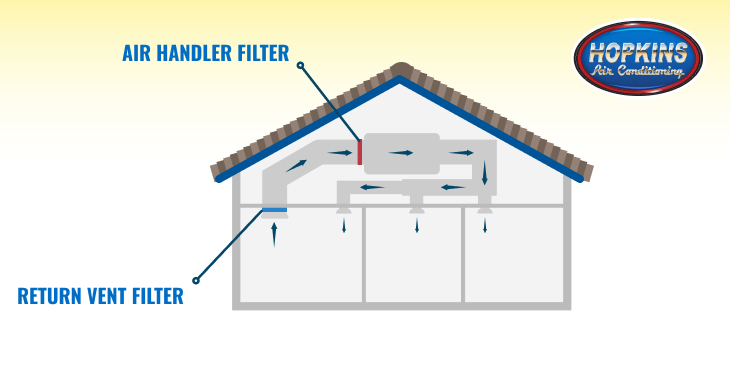
Infographic of a duct system in a home, showing where the return vent filter and air handler filters are located

To determine whether you need air filters for your return vents, you first need to know what they are. Return vents are an important part of your HVAC system. They pull air from your home back into the system for conditioning and redistribution.

So, should return vents have filters? While return vents don’t always require filters, adding them provides additional filtration, improving indoor air quality and keeping dirt and debris out of your system. However, there are pros and cons to consider.

Pros of Return Vent Filters

Some of the benefits of return vent filters include:

  • Adds an extra layer of air filtration
  • Helps reduce dust and allergens in the air
  • Protects the ductwork and HVAC system from debris buildup

Cons of Return Vent Filters

Some of the downsides to return vent filters include:

  • May restrict airflow if not installed or maintained properly
  • Could create inefficiencies if the wrong filter type is used

If you decide to use return vent filters, make sure to select the correct size and type for your system and replace them regularly to avoid airflow restrictions.

Contact Hopkins Air Conditioning today for expert air filter solutions or schedule HVAC maintenance!

Return Air Filters vs. Furnace Filters

Most HVAC systems come with furnace filters, so many homeowners are well-acquainted with them. Because return air filters are less common, it may be useful to review the differences between the two types.

Location and Purpose

Furnace filters go directly into the HVAC unit. They work by trapping pollutants before air circulates through your home. Return vent filters, on the other hand, are installed at the return air grilles and serve as a secondary line of defense.

Filter Size and Type

Furnace filters are not one-size-fits-all. They come in a variety of efficiency ratings and are more effective at capturing smaller particles. Return vent filters are usually thinner and less efficient but can still help reduce dust and debris entering the system.

Maintenance Needs

Most homeowners need to change their furnace filters every 1-3 months, depending on the type and your system’s usage. Return vent filters, if used, also need regular replacement to avoid airflow issues.

By properly maintaining both types of filters, you can get great airflow, reduce strain on your HVAC system, and rest easy knowing you have cleaner air.

Improve Your Home’s Air Quality with Hopkins Air Conditioning

At Hopkins Air Conditioning, we want your home to be as healthy as possible. That’s why we specialize in providing expert air quality solutions. We take a whole-house approach to indoor air quality and HVAC efficiency.

With over 40 years of experience, our team has the skills to tackle any air filter service, including air handlers and return vent filters. We service all brands and are ready to help you with air quality assessments, filter replacement, and HVAC system maintenance.

Repair vs Replace: When Should You Replace Your System?

Repair vs Replace: When Should You Replace Your System?

Even the best-engineered air conditioning system will only last between 15 and 25 years. How will you know when it’s time to repair or replace your system? Here are some signs to look out for.

1. Unusual Sounds

Clunking, squealing or grinding sounds are a sign that something’s seriously amiss with your motor, your fan or your blower. Those types of repairs can be very expensive. If the cost of those repairs comes to more than half the cost of a new AC and your current system is more than a decade old, it’s probably wise to think about getting a replacement.

2. Your Compressor Keeps Breaking Down

The compressor is another AC component that is costly to replace and install. If you have ongoing issues with your compressor and coils and your AC system is old, replacing the entire system may be the most cost-effective solution.

3. Your Home Isn’t Cool Enough

If you can’t feel any real change in the temperature, something may be wrong with your AC system or the duct system that carries and distributes cool air throughout your home. The problem could be something relatively minor like a malfunctioning thermostat or a disconnected duct, but it could also be a serious issue like a damaged motor. If it’s the latter, a replacement may be the option that will save you the most money in the long run.

4. Your Energy Bills Are Going Up

Soaring energy bills are a sign that your air conditioning system is operating inefficiently. This is a common occurrence in an older cooling system. Upgrading your aging system to one that’s more efficient may be able to cut your cooling costs by as much as 25%.

Contact the AC Replacement Specialists

Hopkins Air Conditioning, Inc. in West Palm Beach, FL, can help you find a replacement AC system that will meet your unique needs. We also handle AC repairs and preventative maintenance as well as heating system repairs, installations, and maintenance. Contact our office today to learn more about what we can do for you.

SCHEDULE