
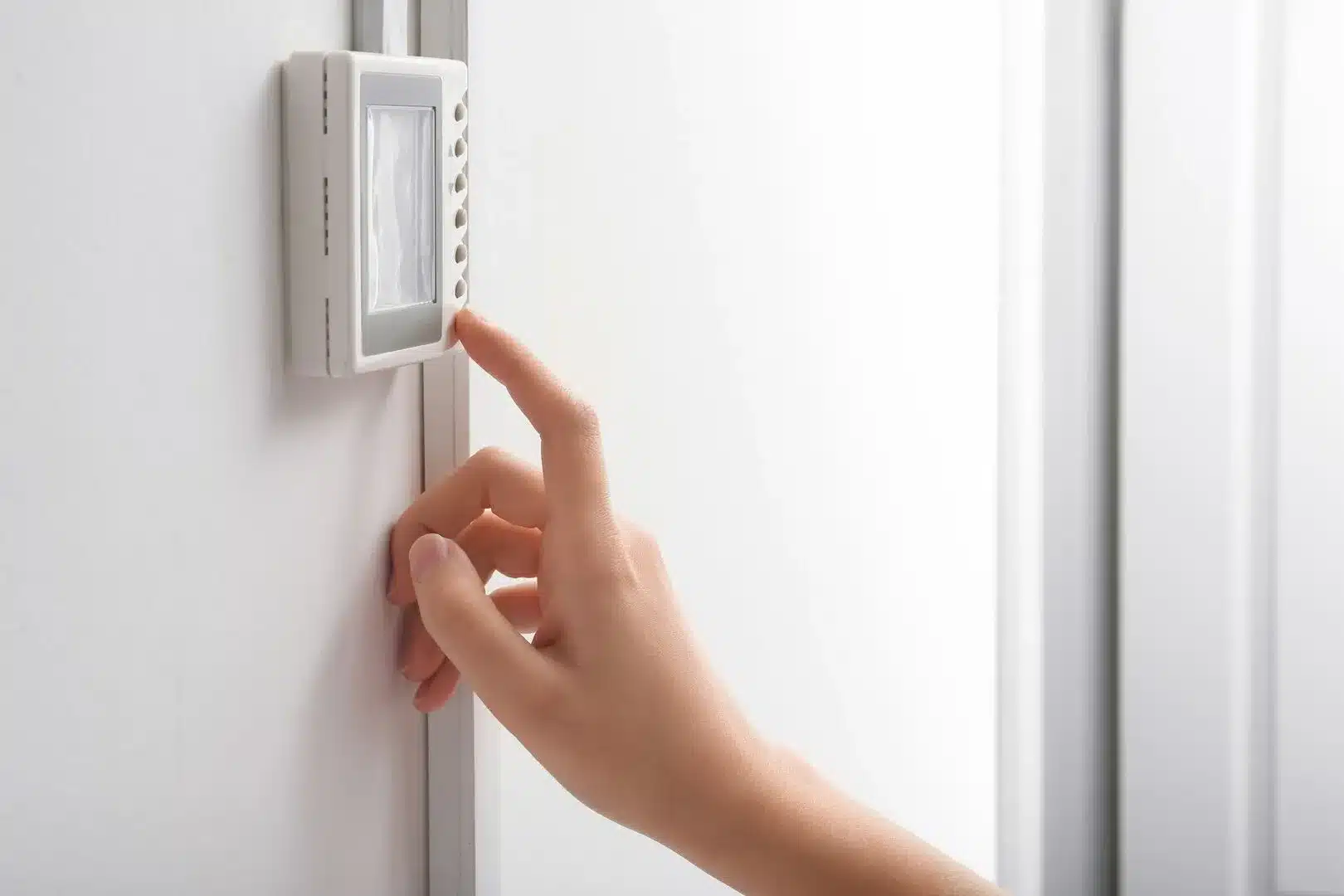
Leaving West Palm Beach for the Holidays? How to Prepare Your HVAC System Before Traveling
Leave the AC on cooling mode while you travel, set no higher than 85 degrees, because a running system pulls moisture from a closed South Florida home. Florida research found that 85 degrees alone dries too little in most homes. Add an early-morning cooling schedule or a dehumidifier to keep humidity below 60 percent. Before you go, change the air filter and clear the condensate drain.
Most West Palm Beach homes need quick HVAC maintenance before a holiday trip, and the most important step is the simplest: leave the AC on.
Holiday weeks here swing between crisp cold fronts and sticky stretches, and a closed house with the system off soaks up that moisture while you're gone.
Should You Turn the AC Off While You're Away for the Holidays?
No, turning the AC off is the one away setting that lets humidity climb in a vacant South Florida home. Relative humidity is the amount of moisture in the air compared with the most it can hold at that temperature. The evaporator coil is the cold coil in your indoor unit where moisture condenses and drains away, and it only does that while the system runs.
According to a Florida Solar Energy Center (FSEC) study of vacant homes, turning the AC off "cannot reliably achieve RH below 65% most of the time." The same report notes that mold and mildew grow when relative humidity stays above about 70 percent for extended periods.
Hopkins Air Conditioning has diagnosed and fixed HVAC systems in West Palm Beach. In more than 35 years of service calls in Palm Beach County, we've found that after a long trip, the most common issue is a musty house with the AC off.
Choose an Away Setting That Keeps Humidity Below 60 Percent
The right away setting keeps the AC in cooling mode, set no higher than 85 degrees, the upper limit in the UF/IFAS Extension guide to closing your seasonal home. The U.S. Environmental Protection Agency's mold and moisture guide recommends indoor humidity below 60 percent, ideally between 30 and 50 percent.
Away Settings Compared: What Florida Research Found
| Away Settings | Research Findings | Best Fit |
|---|---|---|
| AC at 85 degrees | FSEC: "does not work in most homes because AC run time is not sufficient" | A ceiling, not a target |
| AC at 74 degrees from 3 to 5 a.m. | FSEC: "appears to work well in a majority of homes" | Smart or programmable thermostat |
| Dehumidifier set at 62 percent | FSEC: "generally effective" | Whole-home dehumidifier |
Raise the temperature only modestly from your everyday setting. Our guide to thermostat settings for Florida summers covers everyday settings.
A whole-home dehumidifier is a unit tied into your duct system that removes moisture without cooling the house. If your home still feels damp even with the AC running, consider installing a whole-home dehumidifier.
HVAC Maintenance Prep: Run This Checklist Before Leaving
Start your HVAC maintenance prep a few days early to have time to call for help. The ENERGY STAR maintenance checklist recommends checking air filters monthly and inspecting the condensate drain because a plugged drain "can cause water damage in the house and affect indoor humidity levels."
The air handler is the indoor unit, usually in a closet, garage, or attic, that houses the blower and evaporator coil. The condensate drain is the pipe that carries water from the pan under the coil outdoors.
HVAC System Preventive Maintenance Checklist for a South Florida Home
| Step | What to Do |
|---|---|
| 1. Change the air filter | Replace it, or wash it if it is washable |
| 2. Check the condensate drain | Confirm the pan holds no standing water and the line flows, since a clog can overflow with no one home |
| 3. Set the thermostat | Cooling mode, never above 85 degrees |
| 4. Open the interior doors | Bedrooms, bathrooms, and closets, as FSEC advises for unrestricted air circulation |
| 5. Clear the outdoor unit | Power off at the disconnect or breaker, then remove leaves and clutter |
| 6. Turn on thermostat alerts | Confirm the app and notifications work |
| 7. Fix warning signs | Book service for anything on the list below |
Most of this is preventative maintenance you can do yourself. For a slow line, our guide on unclogging AC drain lines covers safe homeowner steps. Refrigerant and electrical work should stay with a licensed technician.
HVAC Warning Signs You Must Not Ignore
Short cycling is when the system turns on and off in quick bursts instead of running full cycles, cutting the run time needed to remove moisture. Refrigerant lines are the copper pipes connecting the indoor and outdoor units.
Call for service before your trip if you notice:
- Short cycling.
- Weak airflow from the vents.
- Water near the air handler or a full drain pan.
- Ice on the refrigerant lines.
- New grinding, buzzing, or rattling.
- A musty odor at startup.
- Bills climbing with no change in use.
On Time, Polite, and Thorough HVAC Upkeep: A Customer Story
Ruth Guerra's review describes a routine visit from our service tech Erwin under her household's maintenance contract. That is the kind of appointment we recommend before a trip, and her review highlights the two things homeowners care about: punctuality and thoroughness.
She Wrote:
“Very nice service tech Erwin. On time, polite, knowledgeable, took time to do a thorough maintenance. All service techs are great, and for that reason we continue to renew our maintenance contract. Happy customers and he also loved our dog!” Read Ruth's Google review.
She writes that all of the service techs are great, which is why her household keeps renewing its maintenance contract. Renewal keeps checkups on schedule, so you don't have to wait for a breakdown.
Protecting Your HVAC System During the Holidays
Your HVAC system continues to protect your home’s comfort and indoor conditions even when you’re away. Planning before vacation can reduce unnecessary energy use, limit system strain, and lower the risk of unexpected heating or cooling issues when you return.
Get a Smart Thermostat to Check on Your HVAC System
ENERGY STAR's smart thermostat guide notes that Wi-Fi-enabled thermostats let you control heating and cooling remotely from your smartphone.
Hopkins Air installs smart thermostats and compatible models that alert you when indoor temperatures deviate from your settings. If the house warms past your set temperature, the AC may not be keeping up, and you can call for service early.
Many smart thermostats also display indoor humidity, and scheduling makes the FSEC early-morning window easy to run. Ask about smart thermostat installation if your current model cannot run a schedule.
Do a Test Run of Your Away Settings a Day or Two Early
One last piece of advice: test your away settings a day or two early. Set your travel temperature, then check on your phone that the AC cycles on during warm afternoons. If it doesn't, book an HVAC tune-up.
Booking HVAC system preventative maintenance in West Palm Beach before the holidays lets one visit check cooling plus the heat strips or heat pump heating mode that sit unused most of the year. Our post on fall heat pump tune-ups in South Florida explains what we check during that visit.
Book a Fall HVAC Tune-Up in West Palm Beach
The best time for a fall HVAC tune-up in West Palm Beach is before Thanksgiving, ahead of the holiday rush. Hopkins Air Conditioning provides 2 preventive HVAC visits per year through our maintenance agreement with priority service at a discounted price. If something fails while you're gone, you can reach our NATE- and National Comfort Institute (NCI)- certified technicians 24/7 for emergency same-day service.
FAQs
What Should a Neighbor or House Sitter Check on the AC While I'm Away?
A neighbor or house sitter should check the thermostat reading and look for water around the indoor air handler on each visit. A reading well above your set temperature suggests the AC isn't keeping up, and a puddle near the air handler usually means a clogged condensate drain. A musty smell at the front door is another reason to call for service. Call a professional instead of opening panels or repeatedly resetting breakers.
Is It Safe to Leave the AC Running for Two Weeks With No One Home?
Yes, leaving the AC running in cooling mode for two weeks is safer for a closed South Florida home than shutting it off. An air conditioner cycles on and off all summer, and an empty house with no cooking or showers puts less strain on it. The real risks during a long absence are a clogged condensate drain that overflows and a failing part that goes unnoticed. A maintenance visit before the trip addresses the drain. A smart thermostat with temperature alerts covers the risk of a failing part.
Does a Hopkins Air Maintenance Agreement Help With Pre-Trip Prep?
Yes, a Hopkins Air maintenance agreement includes two preventative maintenance checks per year on one system, and timing one before a holiday trip is a smart use of it. Each maintenance agreement check is a 20-point inspection and cleaning service that includes checking condensate drains and thermostat calibration. The agreement also includes priority service and access to 24/7 emergency technicians, which matters most when no one is home to notice a problem. The Hopkins Air maintenance agreement page lists everything the plan covers.
Do I Need a Whole-Home Dehumidifier When My AC Works Fine?
A whole-home dehumidifier is not required in every home, but it is a strong option for houses that stay damp or sit empty for long stretches. The Florida Solar Energy Center found that setting a dehumidifier to 62 percent and letting it cycle on and off to maintain the desired humidity generally works well in vacant homes. A whole-home dehumidifier removes moisture without cooling the house, which helps on mild, muggy days when the AC barely runs. Our technician can check your indoor humidity during a maintenance visit and tell you whether the AC alone keeps it below 60 percent.
Should a Cold Front Change My Away Thermostat Setting?
No, a cold front isn't a reason to change your away setting, because a system left in cooling mode runs less when the house is cool. The air behind a South Florida cold front is usually drier, so humidity is less of a worry on those days. The risk returns when warm, muggy air moves back in, and a cooling setting no higher than 85 degrees lets the AC start removing moisture again on its own. A smart thermostat lets you confirm from your phone that the system is cycling normally once the front passes.
Key Takeaways
- The U.S. Environmental Protection Agency advises keeping indoor humidity below 60 percent, ideally between 30 and 50 percent.
- A Florida Solar Energy Center study of vacant homes found that turning off the AC can't reliably keep relative humidity below 65 percent most of the time.
- Mold and mildew grow when relative humidity stays above about 70 percent for extended periods, according to the same FSEC report.
- UF/IFAS Extension recommends setting the air conditioner no higher than 85 degrees in a closed home, while FSEC found that an 85-degree setting does not give most homes enough run time to dry out.
- FSEC found that running the AC at 74 degrees from 3 to 5 a.m. worked well in most homes, and a dehumidifier set at 62 percent was generally effective.
- ENERGY STAR recommends inspecting, cleaning, or changing air filters monthly and checking the condensate drain, since a clogged drain can cause water damage and affect indoor humidity.
- A Hopkins Air maintenance agreement includes two preventative maintenance checks per year on one system, each a 20-point inspection and cleaning service that covers condensate drains and thermostat calibration.
Citations and References
- U.S. Environmental Protection Agency, "A Brief Guide to Mold, Moisture and Your Home" (last updated February 18, 2026): https://www.epa.gov/mold/brief-guide-mold-moisture-and-your-home
- UF/IFAS Extension (EDIS), "Closing Your Seasonal Home," FCS3154/HE887 (revised April 2026): https://ask.ifas.ufl.edu/publication/HE887
- Florida Solar Energy Center (UCF), "Evaluation of the Impact of Vacant Home Space Conditioning Strategies on Summer Relative Humidity, Energy, and Peak Load," FSEC-CR-1487-04, Cummings, Withers and Parker (January 31, 2005): https://publications.energyresearch.ucf.edu//wp-content/uploads/2018/06/FSEC-CR-1487-04.pdf
- ENERGY STAR, "Maintenance Checklist" (undated): https://www.energystar.gov/saveathome/heating-cooling/maintenance-checklist
- ENERGY STAR, "Smart Thermostats" (undated): https://www.energystar.gov/products/smart_thermostats